

Not-Trespassing: The Mackintosh House in Glasgow
Entering the home/portal of Charles and Margaret in Scotland.

❥ This email may be truncated in your inbox. To make sure you are reading the entire post, please move yourself along to a web browser!
More from me + Absolument can be found in these places:
Website | Instagram | Shop Absolument | Book Recs - Merci, thank you tons and tons for reading!
I’m introducing a new series called “Not-Trespassing,” inspired by an architecture tour series I began six years ago. Explore a historic site alongside me, without breaking the law!
When my maternal grandparents passed away, I inherited their little red travel journal. It’s allowed me to discover an entirely hidden part of myself and my family history, which was solidified when I took one of those darn Ancestry.com DNA tests. I started meeting distant family members online and in person (the latter by total accident). It’s been sparking many love affairs with Scotland. I have so many stories to tell, that I might never get around to writing them down properly—I’m working on it!!!
For now, here’s a tiny tribute to my Scottish DNA. It’s in the form of admiration for the Mackintoshes—a husband and wife who are seen as two pillars of Scottish design.
The Mackintosh story


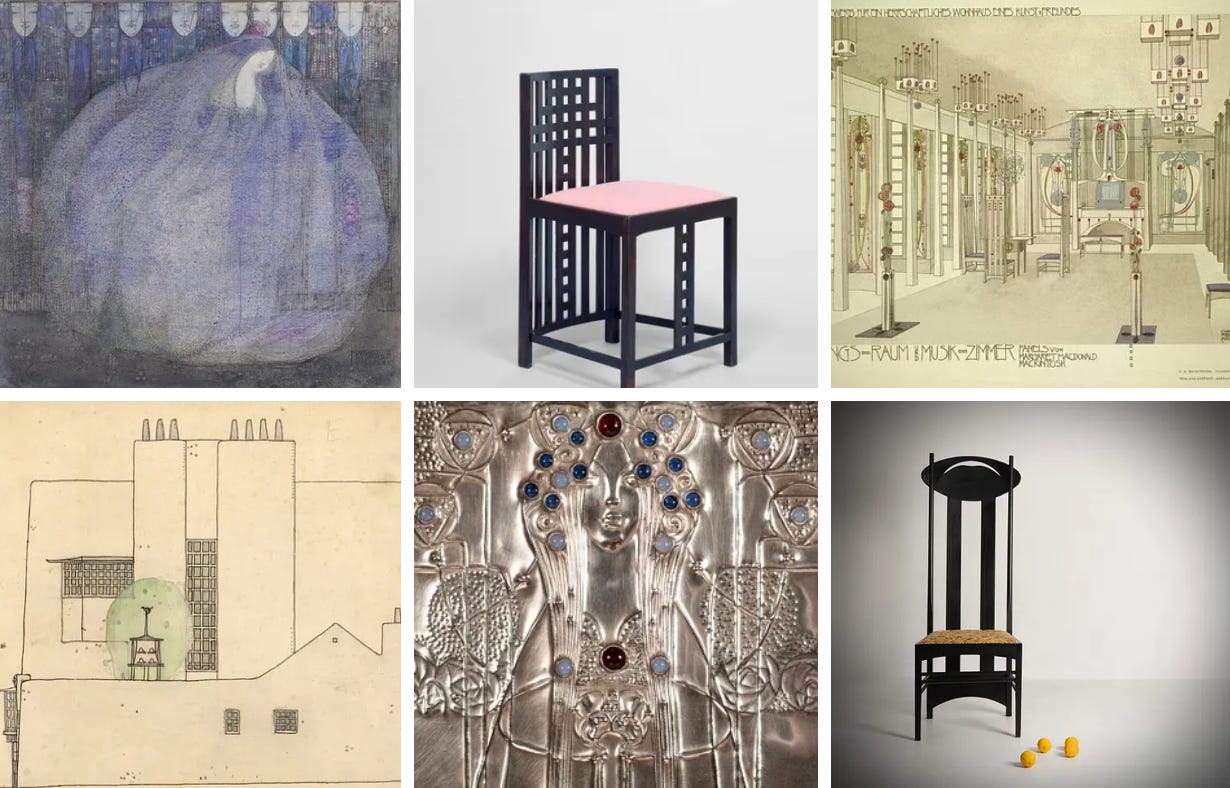
Glasgow-born Charles Rennie Mackintosh (1868-1928) and English Margaret Macdonald Mackintosh (1864-1933) had what scholar Pamela Robertson described as a “mutual affection and attentiveness after nearly thirty years of marriage.” Other accounts mentioned the grand love between the couple, and it’s clear that their softness for one another fortified an already impressive artistic talent.
For Charles, his creative focus centered on architecture, furniture, and lighting, while Margaret’s attention was on textiles, painting, and metalwork. Their union was initially scoffed at for a few reasons: mainly that Margaret was slightly older than Charles, they actually married for love instead of utility, and they worked together in close collaboration rather than Margaret taking on household chores. But they did not let their primary media or their genders box them in—more on that later.
Their home at 6 Florentine Terrace, Glasgow
Instead of building a home from scratch—which most artists and architects prefer—the Mackintoshes searched for an existing home that met their specifications. Most important were: a south-facing orientation to welcome in the sun, spaciousness, interiors that felt proportionate, and not-too-much grandiose detailing. As blank a canvas as possible, for a late-Victorian-era house. Charles and Margaret didn’t have deep pockets, so the bones of the home needed to be easily prepped for a creative transformation.
“The house has done its best to disappear: by 1930 it had been renamed twice, and in 1963 it fell to the wrecker’s ball. Yet from 1906 to 1914, it was the home of Charles Rennie Mackintosh and Margaret Macdonald Mackintosh. Important as the largest property the Mackintoshes lived in and the only home they owned, its interiors were transformed by them into ‘an oasis, a revelation, a delight.’” (via Pamela Robertson)
In 1906, six years after their marriage, the Mackintoshes moved in and began renovations during the summer months. Five bedrooms shrank to three while the drawing room expanded. They lengthened the facade windows to bring in the maximum amount of light—a thing Glasgow suffered from a lack of.
Their overall cost was £925 for the house ($193,000 in 2025) and £900 for its changes ($188k).
The house—sold—wrecked—then reconstructed:
In 1920, the Mackintoshes sold their cherished residence and all of its furnishings to William Davidson. As a promise to Charles and Margaret, William lived in and loved the home for 25 years until his death. Davidson’s two sons donated the interior furnishings to the University of Glasgow, and the school purchased the house the following year. It became a public residence—mainly for seniors and sometimes university staff—until the university demolished it in 1963. Tragically. Their excuse? To make room for a new, multi-story student housing structure.
To make amends for this unforgivable erasure of architecture and local design history, the university aimed to precisely reconstruct the house inside a new on-campus gallery, The Hunterian Art Gallery. Plans were drawn up three years after the house’s demolition. Due to modifications and setbacks, the building took foreeeever to be completed.
Visitors could finally revisit the late Mackintoshes by 1981.


In a very late-1970s-early-1980s-Brutalism sort of way, the facade of The Hunterian shows off its drab, board-form concrete. When standing outside the entrance, a front door and a series of windows hover at the second level above the sidewalk. It’s completely disorienting when first noticing the door with its dangerous drop!
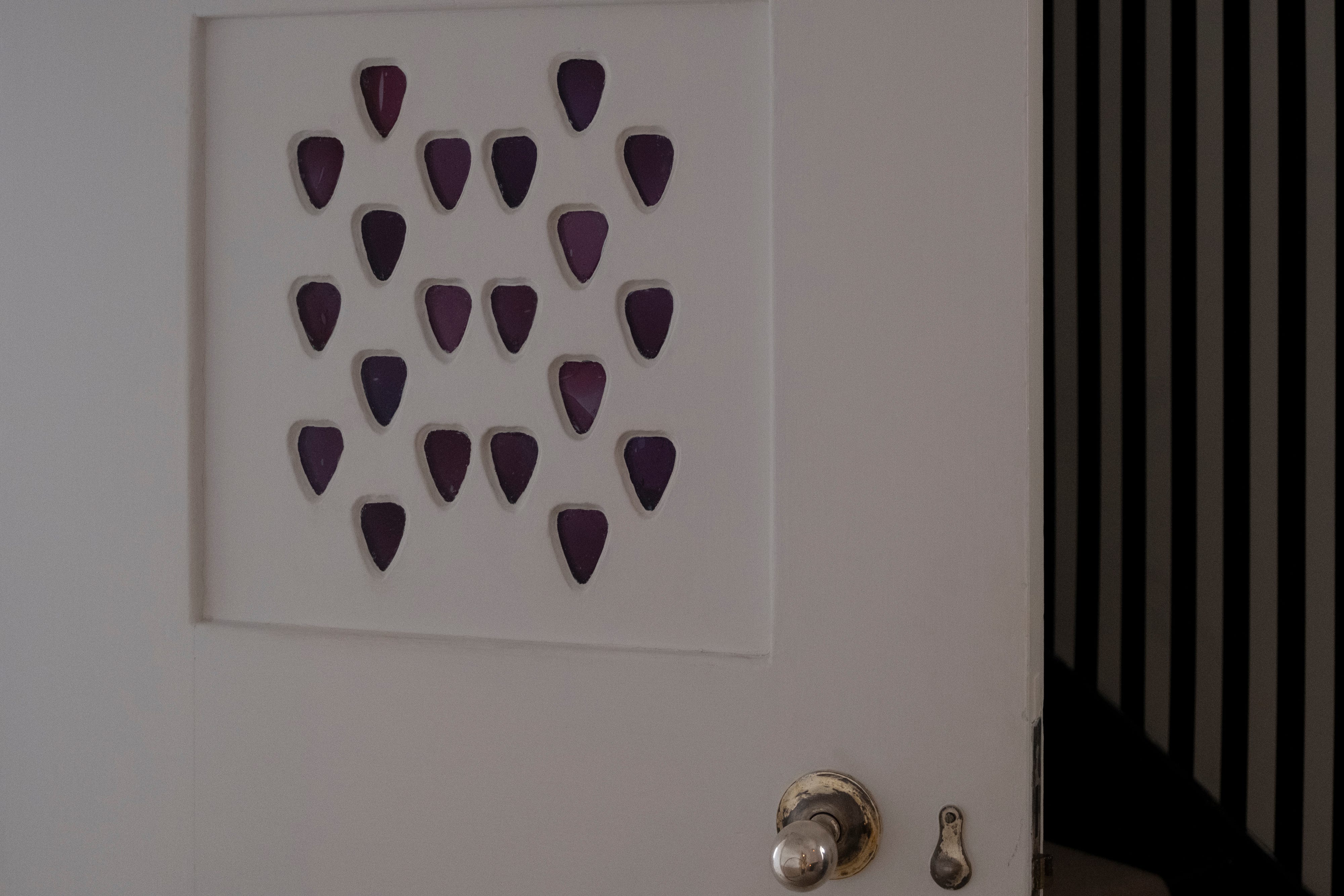
Those who recreated the Mackintosh House were adamant about keeping the house’s truest qualities. Mainly, the south-facing orientation and the simple ornamentation. There’s a Mackintosh touch fossilized in the museum’s Brutalism: the small stained-glass squares in the pure white door.
The house was built at the same elevation, direction, and dimensions as its original. Nicely enough, it’s only 100 meters from the home’s original spot. The effect is that the lighting conditions and ethos of the house feel the same while you’re in its cocoon.
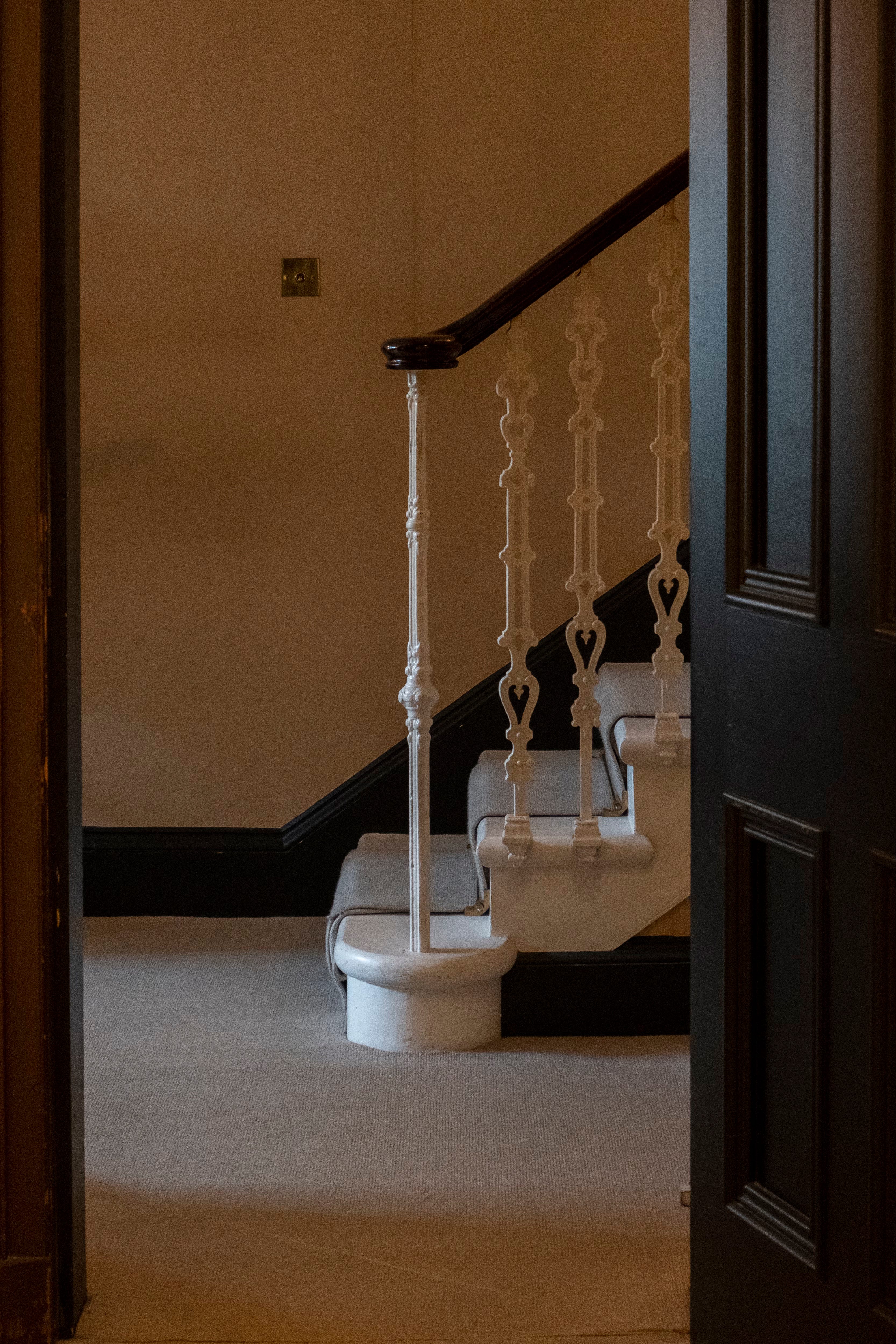
What a truly fantastic experience it is to walk into it from the side hallway! The ornately carved white stair balusters are brightened by the incoming sunlight. I wish I could have entered through the front door, but that would have required a ladder and some extra bravery.
The Mackintosh Portal opens, and the steps through time allow one to enjoy Charles and Margaret’s metalwork, embroidery, wood-carved furniture, trinkets from world travels, hammered lamps, and more. The place glowed, as if each guest was invited into heaven. Truly, design heaven.
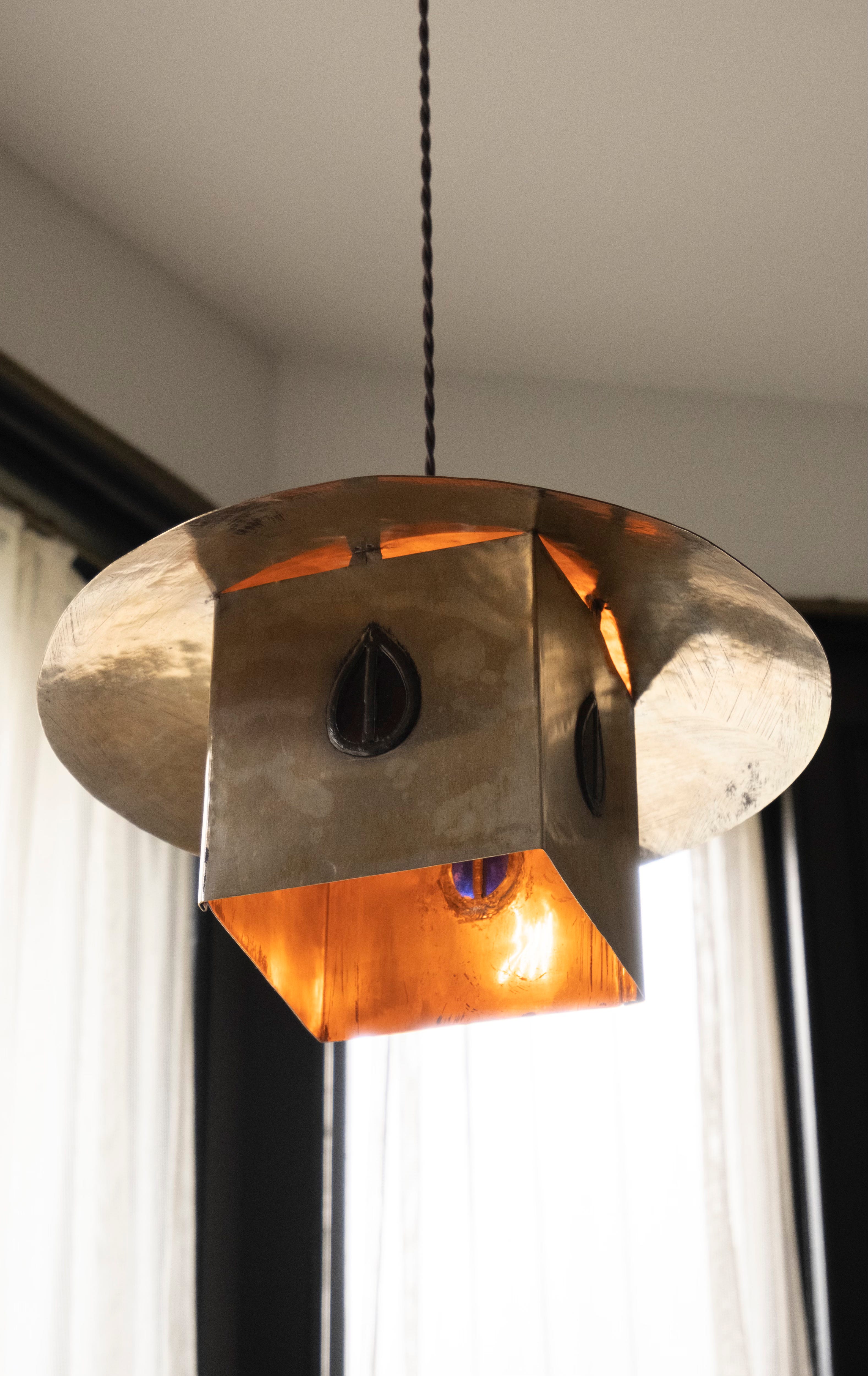
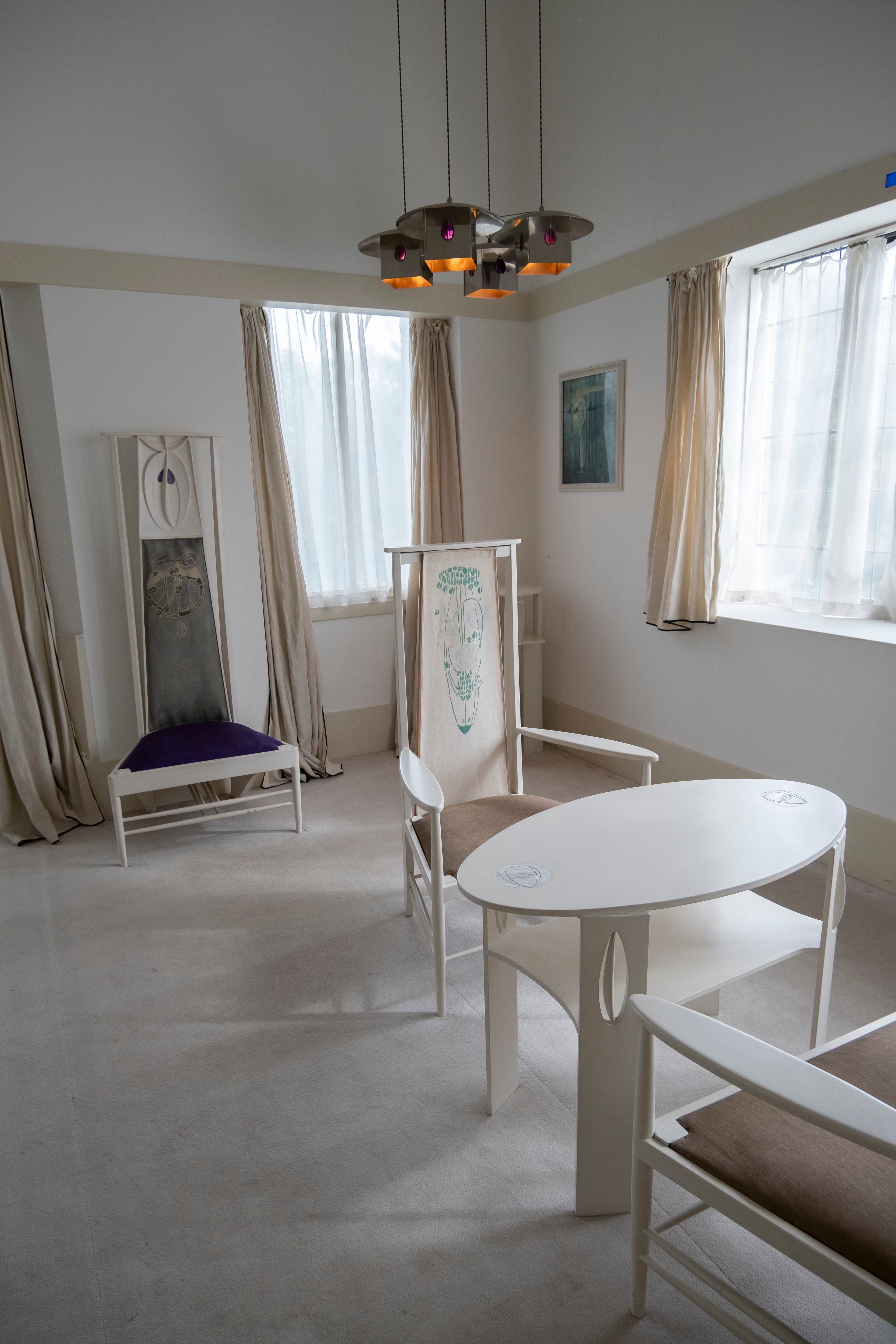


It seems that Charles was primarily the person in charge of form and Margaret given the role of craft, which always bothers me when thinking of gender roles within the arts and design industries. Margaret received a big dose of criticism (in the few times when she was actually publicly acknowledged) because she was seen as inserting too much Art Nouveau into Charles’s modernism. It’s often tough for people to assign any sort of seriousness or merit to “the crafts,” but Margaret makes the strong case that her hands made art at its highest peak.
Between the Mackintoshes themselves, though, Margaret’s role wasn’t diminished in any way. Which is rare! Especially in the late 1800s-early 1900s. Charles emphasized to her: “You must remember that in all my architectural efforts you have been half, if not three-quarters, in them.”
The aspects of the home and its furnishings that sang the strongest, to me, were those that Margaret touched. To see the embossed tin cabinet doors, the checkered and silken thread stitches layered onto furniture upholstery, or her carved language touching the edge of a chair—Margaret’s details were more than emphatic punctuation. Charles added spirit to the work (although much more humbled), but it’s impossible to imagine his work without hers and vice versa.
Other epochs, design styles, and places whirled in my mind while experiencing the house. I remember speaking with the darling docent (we’re IG friends now!!), saying: “This is like Frank Lloyd Wright meets Japan meets Art Nouveau…but somehow better.” I know I shouldn’t make assumptions about someone’s influence(s), but so much was coming up for me, all at once! The effect was really inspiring.
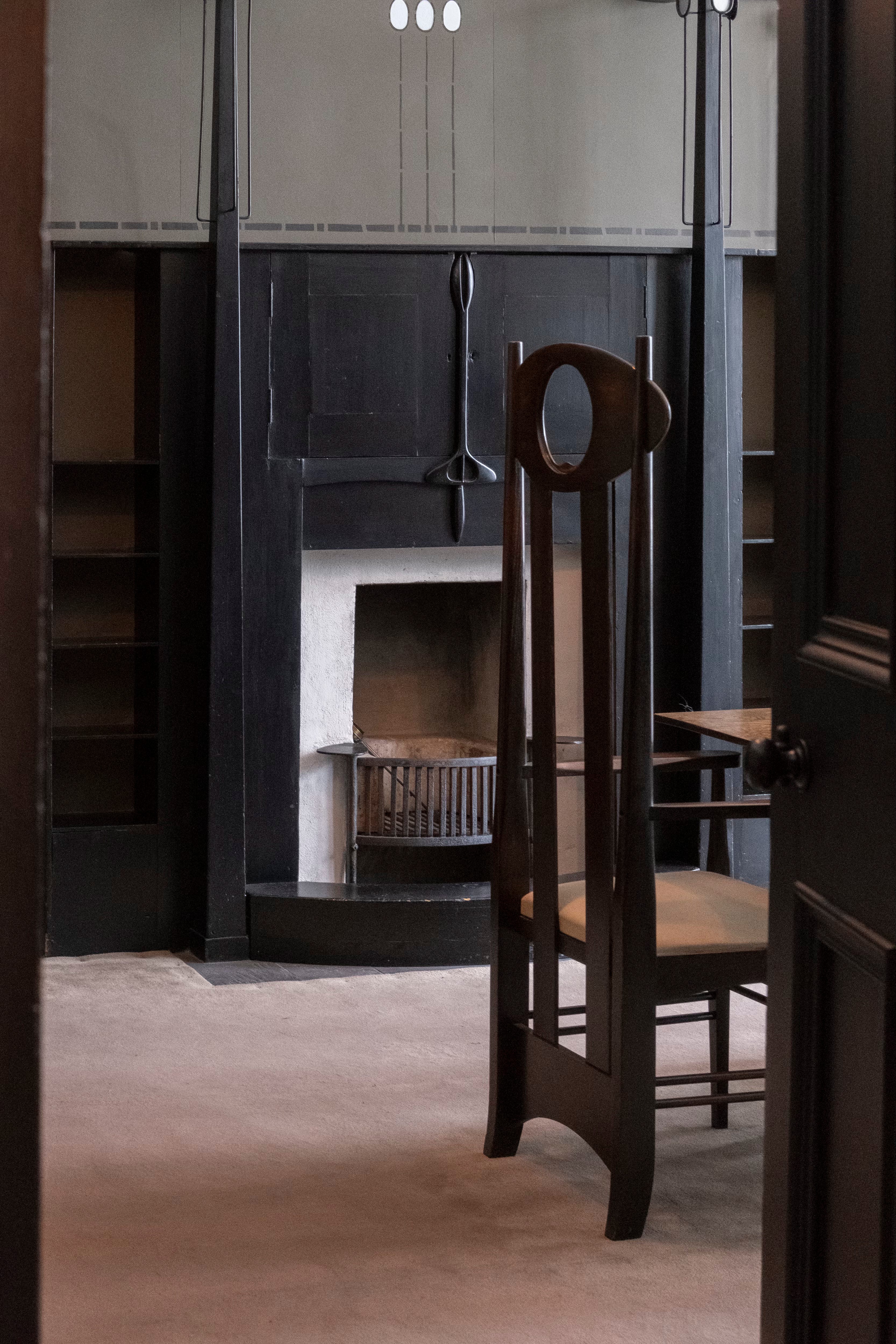
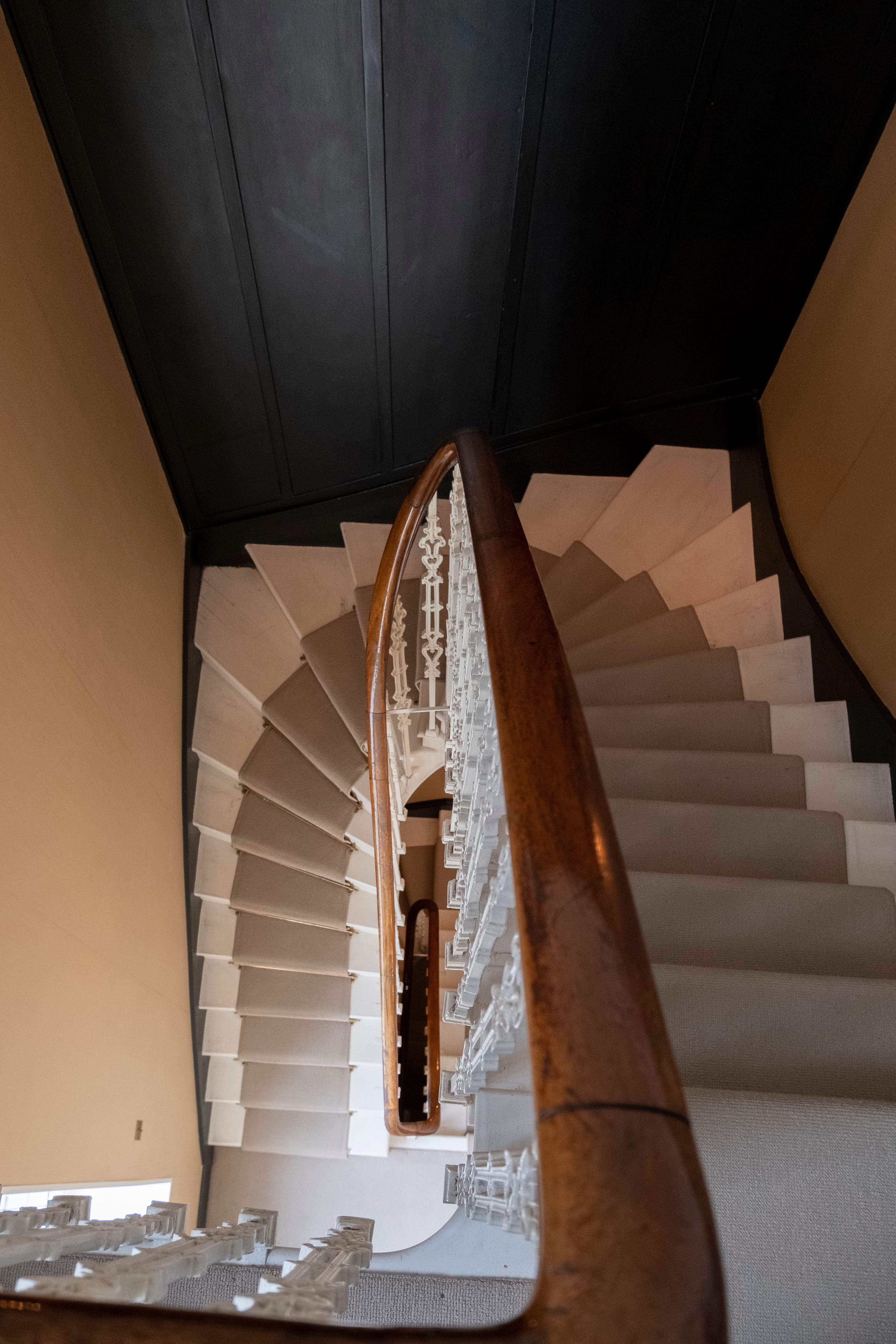


I honestly walked into this recreated glimpse of their home with very little knowledge of the Mackintoshes, and walked out with a rush. It felt like they floated me through their lovely home while teaching me about the wonders of materials and making me fall totally in love with their sensibilities.
I left Charles and Margaret’s house feeling my semi-Scottish heart beaming, as if it were made of purple, Mackintosh-designed stained glass.
Visit!
You can visit during The Hunterian Art Gallery’s opening hours. Visits to the gallery are free, but the Mackintosh wing costs 10 GBP per person. No reservation is required.
Related notes:
One of the docents at the Eames House, Magdelena, who trained me to give interior tours of Charles and Ray’s home almost a decade ago, noticed that I was in Scotland. She urged me to visit the Mackintosh Hill House. I didn’t have enough time, but I reassured her that I already had a Mackintosh on our schedule! The Hill House is undergoing a fascinating preservation effort, and is miraculously open to visitors at the same time. Look at the structure that The National Trust for Scotland built as a temporary conservational membrane around the house:
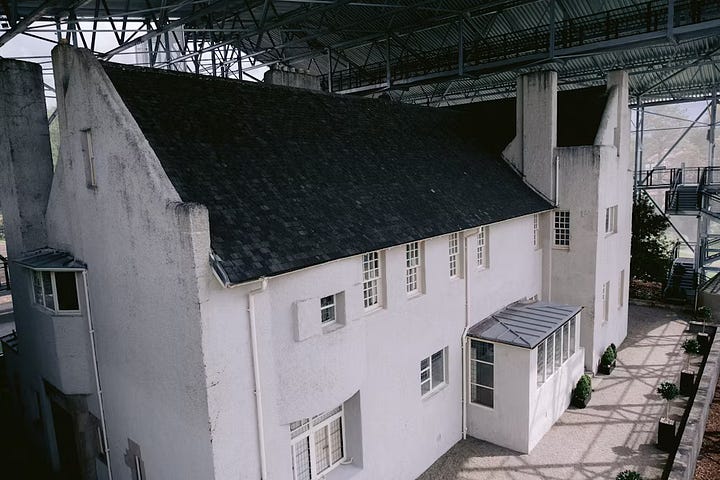
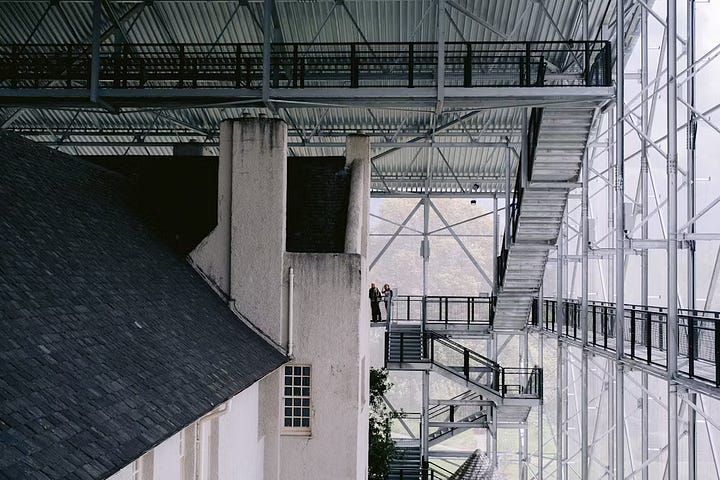
The Hill House inside its protective preservation structure. Photographs c/o National Trust for Scotland. The National Trust for Scotland writes,
“The external render of the property has not proved watertight, and the walls have gradually become saturated and are crumbling, with water now threatening the interiors. If we don’t act, the house will be irreparably damaged and we’ll lose its iconic architecture and unique interiors forever.
We’ve embarked on a 10-year conservation program, which will allow continued public access to the house. Stage one opened to visitors in early June 2019, with a protective steel frame structure covered in chainmail mesh, featuring walkways around and over the top of the house. This structure, along with a new visitor centre, delivers a unique heritage visitor experience, offering views of the Hill House that have never been seen before, even by Mackintosh himself.”
Charles (at 33 years old) and Margaret (at 28) entered the “House for an Art Lover” design competition together, creating an imaginative home in the new “modern” style for an art collector. Their entry didn’t win, and the project was never realized because the patron didn’t think any of the entries were worthy of being built. Clearly a psychopath! Eighty years later, someone actually built their competition entry from the architecture drawings.


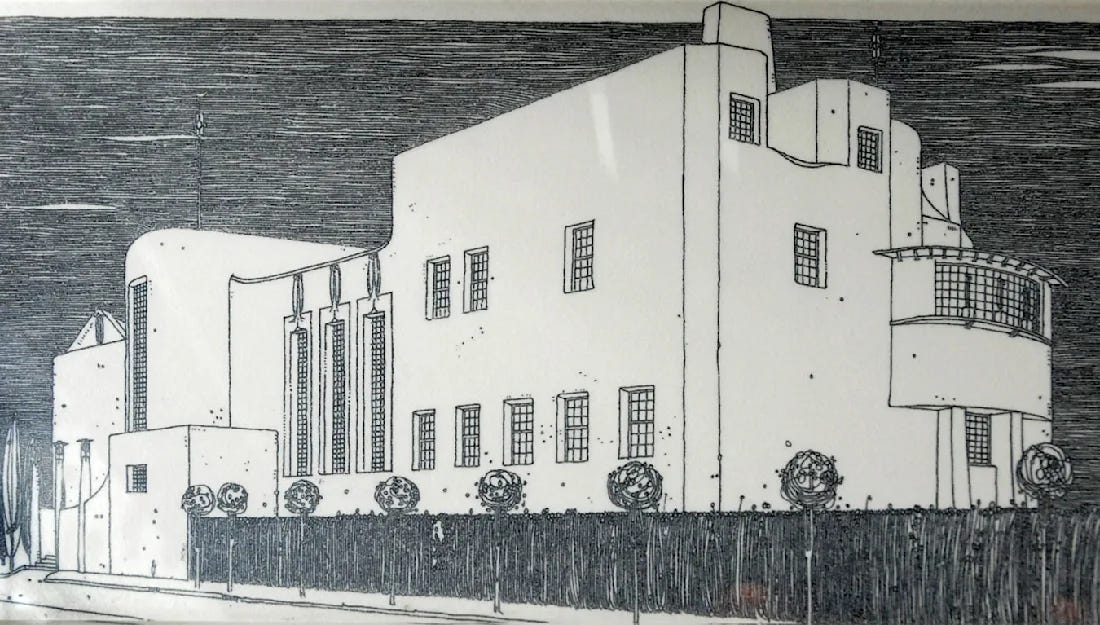
Substack note synchronicity—visiting the house the same week that Lauren Sands shared these photographs:
After visiting, it’s clear to me that some of these images were taken of the actual house itself, before it was demolished. Some of these rooms don’t exist in the museum (the images in the four corners). A huge shame!!! My wishful heart hopes that they will add more rooms in the future.
I’m having deep, semi-irrational intuition pings telling me that my husband and I need to save up for a tiny cottage in Scotland. I want to live in the Basque Country forever, but buying property in France as an American without an official job contract is pretty tough. I’m going to sit on the idea as I keep saving my pennies. Wouldn’t it be incredible to own a piece of “the homeland?” My mom made the point that all of our close family on my Nana’s side left Scotland for other countries, and that it would be soul-enriching for me to bring my family lineage back there somehow. Even if it’s a one-room farming cottage in the middle of nowhere—preferably with sheep involved!
**
Kelsey Rose
Finally had time to read this (which I've been saving!) - what a magical, magical place!! An eventual Scotland must visit!
The mix of art nouveau and modernism I didn't know I needed! I can't believe this design mix was seen as an issue, I think its absolutely perfect! Thank you for sharing this.